Comprehensive Weight Loss Solutions

Northern Light Eastern Maine Medical Center has been helping people reshape their lives for more than 35 years. The Northern Light Comprehensive Weight Management team is dedicated to helping you achieve success in the weight loss treatment method of your choice.

The elements of a successful surgical weight loss program reach far beyond the operating room. Our multidisciplinary approach to weight loss incorporates nutritional education, physical therapy, behavioral counseling, and peer support groups to provide individualized care to our patients.

Managing your weight with the help of Northern Light Comprehensive Weight Management means more than losing pounds, it means gaining the power to reshape your life. Together, we’ll work toward changing the way you look at food, improving your relationship with food, decreasing your medication use, reducing your risk of obesity-related diseases, improving mental health, increasing your energy, and improving the quality of the time you spend with your family and friends. In this booklet you will find information on how to best prepare yourself for both before and after surgery to achieve optimal success!

Why is weight loss surgery right for me?

Many patients with obesity have tried to lose weight on their own with diet and exercise. Many have had some success, only to regain weight. More often, patients have little to no success with diet and exercise alone. This is not a result of lack of willpower or the wrong diet. When a patient has a body mass index (BMI) greater than 35, their chances of reaching a normal body weight for a lasting period is less than 1%. That’s why surgery is an option for patients with severe obesity. Unfortunately, many patients who could benefit from surgery don’t know if surgery is right for them. Only about 1% of people who qualify annually actually get surgery.

Weight loss surgery does not just treat the disease of obesity, but it effectively treats and reduces the risk of acid reflux, arthritis, cancer, diabetes, heart disease, high blood pressure, high cholesterol, and sleep apnea.

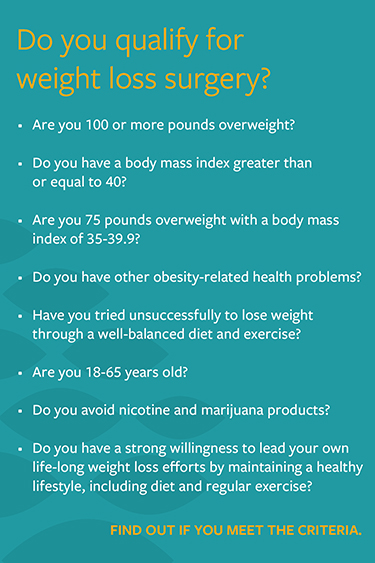
Qualifications for Weight Loss Surgery for Most Insurances:

  1. If you have a BMI ≥35
  2. If you have a BMI ≥30 and type 2 diabetes
  3. If you have a BMI of 30–34 and do not achieve lasting weight loss or co-morbidity improvement using nonsurgical methods.

What is weight loss surgery?

Weight loss surgery is also known as weight loss and metabolic surgery. These terms are used to reflect the effect these operations have on patients’ weight and the health of their metabolism. These operations also may prevent future health problems. The benefits allow patients with obesity who choose to undergo treatment to enjoy a better quality of life and a longer lifespan.

Today’s weight loss surgery has been refined over the course of many decades and is among the best-studied treatments in modern medicine. It is performed with small incisions using minimally invasive surgical techniques (laparoscopic and robotic surgery). These advancements allow patients to have a better overall experience with less pain, fewer complications, shorter hospital stays, and faster recovery. The procedure is extremely safe, with complication rates that are lower than common operations such as gallbladder removal, hysterectomy, and hip replacement.

The goal of these operations is to modify the stomach and intestines to make the stomach smaller and may also bypass a portion of the intestine. This results in less food intake and changes how the body absorbs food for energy, resulting in decreased hunger and increased fullness. These procedures improve the body’s ability to achieve a healthy weight. The common procedures endorsed by the American Society for Metabolic and Bariatric Surgery are listed and explained below. Each surgery has its own advantages and potential drawbacks. Your surgeon will review your health history and work with you to determine which surgery is best for you.

Surgical Weight-Loss Media

Are you interested in learning more about weight loss surgery?

Watch our information session presented by Medical Director Dr. Matthew Sharbaugh to better understand your options and what to expect.

News

View Blog Articles

Our Offerings

Our team of registered dietitians, psychologists, advanced practitioners, and surgeons offer a selection of services.

Gastric Sleeve (VSG)

The Laparoscopic Sleeve Gastrectomy, often called the “sleeve”, is performed by removing approximately 80% of the stomach. The remaining stomach is the size and shape of a banana.

The Procedure

  1. The stomach is freed from organs around it.
  2. Surgical staplers are used to remove 80% of the stomach, making it much smaller.

How it Works

The new stomach holds less food and liquid helping reduce the amount of food (and calories) that are consumed. By removing the portion of the stomach that produces most of the “hunger hormone”, the surgery has an effect on the metabolism. It decreases hunger, increases fullness, and allows the body to reach and maintain a healthy weight as well as blood sugar control. The simple nature of the operation makes it very safe without the potential complications from surgery on the small intestine.

Gastric Bypass

The Gastric Bypass has been performed for nearly 50 years!

The Procedure

  1. First, the stomach is divided into a smaller top portion (pouch) which is about the size of an egg. The larger part of the stomach is bypassed and no longer stores or digests food.
  2. The small intestine is also divided and connected to the new stomach pouch to allow food to pass. The small bowel segment which empties the bypassed or larger stomach is connected into the small bowel approximately 3-4 feet downstream, resulting in a bowel connection resembling the shape of the letter Y.
  3. Eventually the stomach acids and digestive enzymes from the bypassed stomach and first portion of the small intestine will mix with food that is eaten.

How it Works

The gastric bypass works in several ways. Like many bariatric procedures, the newly created stomach pouch is smaller and able to hold less food, which means fewer calories are ingested. Additionally, the food does not come into contact with the first portion of the small bowel and this results in decreased absorption. Most importantly, the modification of the food course through the gastrointestinal tract has a profound effect to decrease hunger, increase fullness, and allow the body to reach and maintain a healthy weight.

The impact on hormones and metabolic health often results in improvement of adult onset diabetes even before any weight loss occurs. The operation also helps patients with reflux (heart burn) and often the symptoms quickly improve. Along with making appropriate food choices, patients must avoid tobacco products and non-steroidal anti-inflammatory drugs (NSAIDs) such as ibuprofen and naproxen.

Our nationally recognized Surgical Weight Loss Program is committed to delivering high-quality, patient-centered care. Read our accreditation announcement to learn more about our achievements, or explore our designation as a Center of Excellence, recognizing our commitment to the highest standards in weight loss care. You can also review our national quality and safety data to see how we measure up.

Looking for additional resources? Visit the American Society for Metabolic and Bariatric Surgery patient page for trusted information about procedures, safety, and long-term success.

Our Medical Nutrition Therapy services provide personalized nutrition evaluations and tailored solutions designed to meet your individual needs and support your long-term health goals. You’ll work closely with a registered dietitian who will guide you every step of the way—Explore the dietitian’s role in nutrition care to better understand how they support safe, personalized, effective, and sustainable treatment options for patients.

What is a clinical registered dietitian?

A registered dietitian nutritionist (RDN) is a credentialed healthcare professional who applies evidence-based information about nutrition and diet therapy to aid in the health and wellness of individuals, groups, and communities. Clinical dietitians provide patients with personalized education and treatment methods for general wellbeing or for specific diseases.

Dietitians provide clinical nutritional education and counseling for people with a wide range of conditions such as:

  1. Diabetes
  2. Gastroesophageal Reflux Disease
  3. High cholesterol
  4. High blood pressure
  5. Kidney disease
  6. Weight management for children and adults
  7. Eating disorders
  8. Malnutrition
  9. Unexplained weight loss
  10. Heart Disease
  11. Polyendocrine Metabolic Ovarian Syndrome

Nutrition services can be individualized to help you achieve a specific goal. Dietitians provide services that include:

  • Nutritional counseling/education
  • Support groups
  • Metabolism testing
  • Individualized food plans to help reach a specific goal

If you are interested in meeting with a registered dietitian, contact Comprehensive Weight Management today!

Our Weight Management Medication services are overseen by advanced practitioners who specialize in obesity medicine. When appropriate, prescription medications may be used as part of a comprehensive, medically supervised plan to support weight loss, improve metabolic health, and help you achieve sustainable results.

Our Behavioral Medicine services provide personalized mental health support to enhance your overall well-being and address the emotional and behavioral aspects of weight management. Treatment plans are tailored to your needs and may include support for conditions such as anxiety, depression, disordered eating, stress management, and lifestyle adjustment.

Our specialists use evidence-based approaches to help you build healthier habits, improve coping strategies, and maintain long-term success. Learn more about our Behavioral Medicine services.

We offer monthly support groups covering a variety of topics to help you stay connected, informed, and motivated throughout your journey. These sessions provide a supportive environment where you can share experiences, gain insights, and learn from both peers and healthcare professionals.

Ongoing care is an essential part of long-term success after weight loss surgery. The American Society for Metabolic and Bariatric Surgery recommend annual follow-up visits with your Comprehensive Weight Management care team to help you stay on track and achieve your long-term health goals. If you are looking to schedule long term, follow up after weight loss surgery call our office today!

Our team offers comprehensive body analysis services, including indirect calorimetry testing, body composition analysis, and physical measurements. These tools provide valuable insights into your metabolism and overall health, helping guide personalized treatment plans and track your progress over time.

Indirect calorimetry testing measures how many calories your body needs at rest, giving you a clearer understanding of your unique metabolic rate. This information helps create more accurate, personalized nutrition and weight management plans to support your health goals.

Insurance Coverage for Weight Loss Surgery

This guide is designed to provide individuals with the knowledge needed to successfully work with their insurance provider and become an advocate for change. It offers readers information discussing the effects of obesity and severe obesity, tips for working with your insurance provider, detailed information concerning the treatment options available for severe obesity and much more.

This is an excellent tool for people who are affected by severe obesity and seeking weight-loss surgery. People rely on their insurance provider to assist them in the process of seeking access to safe and effective medical treatment. Many times, this process can be difficult when working with insurance providers. In addition, the process can often seem complicated, and physically and emotionally draining. Consult the following resources from the Obesity Action Coalition:

Looking for more detailed information regarding surgical weight-loss?

View Frequently Asked Questions

Contact Surgical Weightloss Services

If you are unsure if you are a candidate for weight loss surgery or would like to meet with our providers to discuss all your options, contact us today!

Areas of Interest:


Note: Please do not use this form to send patient information. Your private health information (PHI) is confidential and should only be discussed with your provider.

Care Locations

Enter a Zip Code

To better serve you, please enter a zip code to help find a location near you. Without a zip code the results below are alphabetical.

Related Providers

Enter a Zip Code

To better serve you, please enter a zip code to help find a location near you. Without a zip code the results below are alphabetical.